Article
Running Cadence Explained: The 180 Myth, Overstriding, and How to Raise It Safely
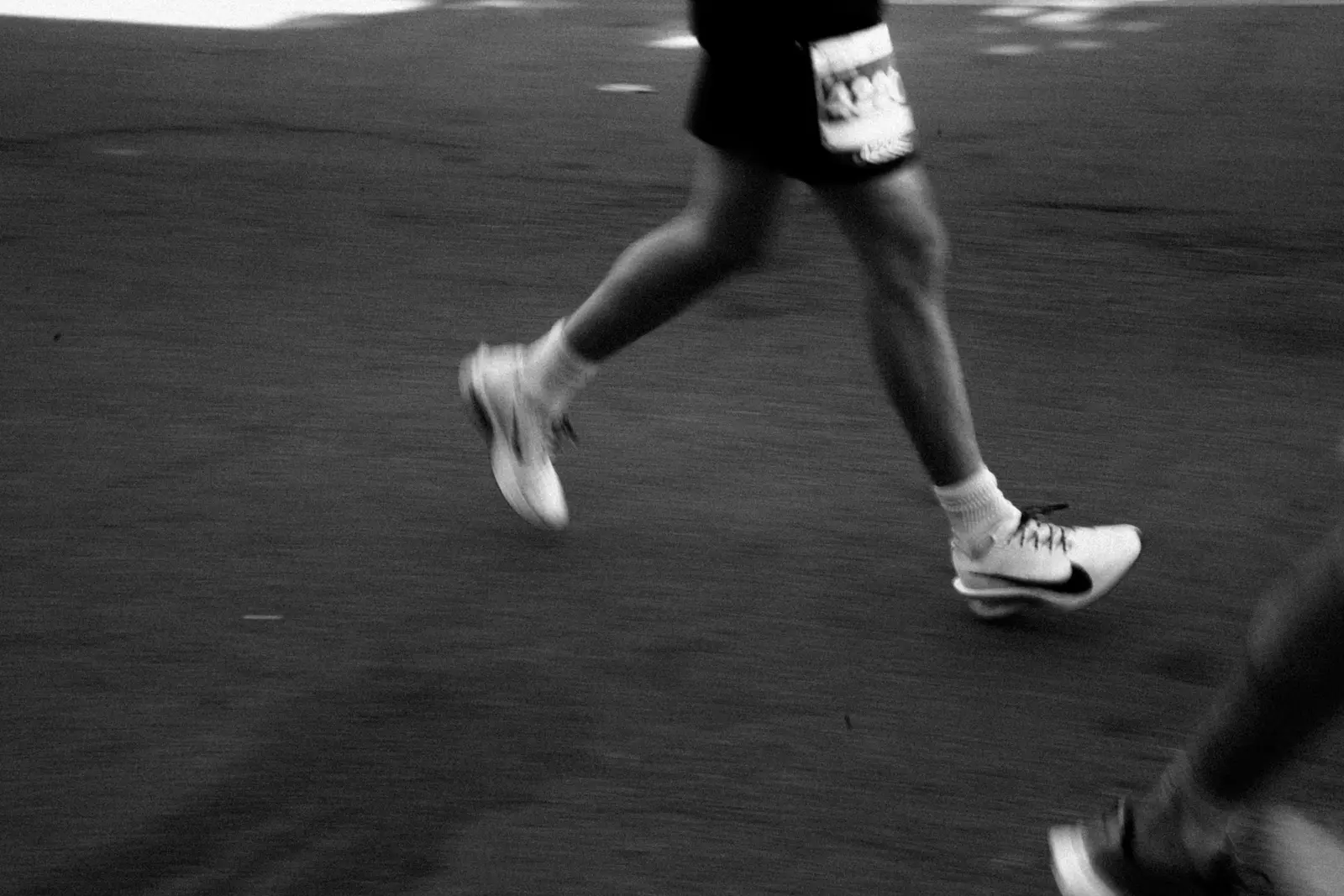
Glance down at a GPS watch mid-run and you'll usually find a number quietly ticking away next to pace: cadence, in steps per minute. Most runners have heard that "180" is the target and leave it there — a number to chase without knowing where it came from or whether it applies to them. It's worth unpacking, because the real story is more useful than the myth.
What cadence actually is
Cadence is simply how many steps you take per minute, counting both feet. A watch reporting 165 spm means your feet are hitting the ground 165 times every minute, roughly 2.75 times per second. It's a measure of turnover — how quickly your legs are cycling — independent of how far each step carries you.
Speed is the product of two things: how long each step is (step length) and how often you take one (cadence). Two runners can hit the same pace with very different combinations — one with a quick, short stride, another with a longer, more loping one. Cadence alone tells you nothing about speed; it only becomes useful alongside step length and how the two interact as effort changes.
The 180 myth — and its real origin
The "180 steps per minute" number traces back to legendary coach Jack Daniels, who spent the 1984 Los Angeles Olympics trackside counting the cadence of elite distance runners across almost every event. What he noticed was striking: nearly all of them, regardless of pace, height, or distance, were turning their legs over at 180 steps per minute or higher. He wrote the observation up, it appeared in his book Daniels' Running Formula, and from there it took on a life of its own online — quietly mutating from "a description of how a small, exceptional group of Olympic runners happened to move" into "a universal number every runner should hit."
That mutation is the myth. Daniels was describing already highly trained, biomechanically efficient athletes racing at elite speeds — not prescribing a cadence that, if adopted, would make anyone else run like them. Cadence also varies naturally with leg length and height: a runner who stands 1.55 m and one who stands 1.95 m, moving at an identical pace, will typically settle on quite different natural cadences, and neither is doing anything wrong. Treating 180 as a pass/fail line ignores basic anatomy.
Cadence and speed: how they actually relate
As pace quickens, both step length and cadence tend to increase — but not at the same rate. Across most of the everyday training range, from easy jogging up to threshold effort, the increase in speed comes mostly from longer steps; cadence itself climbs only modestly. It's really only as you approach sprinting speeds that cadence rises sharply, because step length eventually runs into biomechanical limits.
That's why cadence looks fairly stable across a wide range of paces for any individual runner, and why comparing your cadence against a single fixed number misses the point — the more useful comparison is against the range typically seen at a given effort:
| Effort level | Typical cadence (spm) | What's happening |
|---|---|---|
| Easy / recovery pace | 155–170 | Turnover sits at its natural resting rate for the individual; step length is short and relaxed. |
| Moderate / tempo pace | 165–175 | Step length lengthens; cadence rises only slightly over the easy-pace baseline. |
| 5K–10K race effort | 170–185 | Both step length and turnover contribute meaningfully to the added speed. |
| Elite distance racing | 180–200 | The population Daniels originally observed — highly trained athletes at high absolute speeds. |
These are illustrative ranges pooled from watch and lab data, not thresholds you pass or fail. A recreational runner sitting at 162 spm on an easy run is not doing anything wrong; a runner at 190 spm on the same easy run is not automatically more efficient.
How to measure your own cadence
Most GPS watches with a running-dynamics feature report average cadence automatically after a run, and some show it live. If yours doesn't, you can measure it manually:
- Settle into a steady pace for at least a minute so the count reflects a real rhythm, not the surge of starting off.
- Count every time one specific foot (say, your right) strikes the ground for 30 seconds, then multiply by four. Counting one foot rather than both makes it easier to keep an accurate tally while running.
- Repeat once or twice and average the results — a single 30-second count can be noisy.
Do this at a couple of different paces (easy and moderate) rather than once, since cadence is pace-dependent.
Overstriding and the injury link — what the evidence actually shows
Overstriding means your foot lands well ahead of your body's centre of mass, rather than closer to underneath it. The lower leg reaches forward, the knee is relatively straight at landing, and the impact acts partly as a brake rather than propelling you forward. It's often — though not always — paired with a lower cadence at a given pace, because a slower turnover forces a longer reach-forward stride to hit the same speed.
The research most often cited here is a 2011 study by Heiderscheit and colleagues, which found that increasing step rate by 5–10% above a runner's preferred cadence measurably reduced impact loading rates and stress at the hip and knee joints, without requiring any other change in running form. That finding has made small cadence increases a common tool in rehab settings for patellofemoral pain and some tibial stress injuries, alongside other components of a treatment plan.
It's worth being precise about what this does and doesn't show. The evidence supports that raising cadence modestly reduces certain measurable loading forces — it does not establish that low cadence causes injury, or that raising cadence prevents it, for runners with no symptoms. Injury is multi-factorial: training load, recovery, strength, footwear, and individual anatomy all matter, and plenty of runners with a naturally low cadence run for decades injury-free. Cadence is one lever, useful in specific situations, not a universal insurance policy.
How to gently raise cadence, if you decide to
Cadence work is worth doing if you're troubleshooting an overstriding-pattern injury with a clinician, or if a coach or gait analysis has flagged your cadence as unusually low relative to your pace and you want to experiment. It's not something every runner needs to chase.
If you do want to shift it:
- Move in small steps. Aim for a 5–10% increase over your current baseline, not a jump straight to a round number like 180. A runner starting at 158 spm should target roughly 166–174, not an arbitrary industry number that may be well outside their natural range.
- Use a metronome, not willpower. A metronome app or your watch's audio cadence alerts, set a few beats above your current rate, gives you an external rhythm to match — far easier to hold than trying to consciously count and adjust.
- Practise in short bursts. Run to the beat for 60–90 seconds at a time within an easy run, then let your stride relax back to normal. Trying to hold a new cadence for an entire run before your body has adapted tends to feel forced and unwind quickly once you stop concentrating.
- Add turnover drills. Quick-feet drills, fast (but low-amplitude) high knees, and short strides with a deliberately rapid leg cycle all build the motor pattern of faster turnover separately from a full run.
- Give it weeks, not one session. A cadence shift is a change to a deeply grooved motor pattern. Rushing it — or jumping several steps beyond the 5–10% range in one go — just shifts load onto other structures, notably the calf and Achilles, that haven't adapted yet.
Worked example: raising cadence from 158 to 168 spm
A runner measures their easy-pace cadence: 30-second counts of the right foot come out to 39 and 40 strikes, giving 156 and 160 spm — an average of 158 spm.
They decide, on a physio's advice after a bout of anterior knee pain, to nudge that up by roughly 6%: 158 × 1.06 ≈ 167, rounded to a metronome setting of 168 bpm.
Week 1: two 60-second efforts at 168 bpm within an otherwise normal easy run, stride relaxed back to natural rhythm in between. Week 2–3: three to four efforts of 90 seconds each, spread across easy runs. Week 4–6: the metronome comes out less often. A watch check shows average easy-run cadence has drifted from 158 up to roughly 163–165 — not all the way to 168, but a real, sustained shift achieved gradually rather than forced from day one.
That gradual, partial result is the realistic outcome of cadence work — a meaningful change in turnover, arrived at over weeks, not an overnight jump to a target number.
Should you actually change it?
If you're currently uninjured, your cadence falls within the ranges typically seen at your training paces, and running feels efficient, there's no evidence-based reason to force a change. Cadence is a troubleshooting tool for a specific problem — an overstriding pattern linked to symptoms, or a gait assessment that's flagged something worth addressing — not a number every runner needs to hit.
If you do start working on it, keep the rest of your training numbers in view too. The pace calculator is a quick way to convert a goal time to the pace you'll be holding while you experiment with turnover, so a cadence change doesn't quietly turn into a pace change you didn't intend.